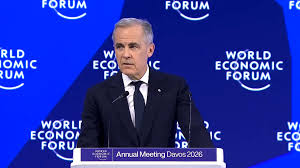
Mark Carney at the World Economic Forum, Davos
Investigation

The Davos Contradiction

In his speech at Davos, Mark Carney spoke eloquently of capital, talent, and fiscal capacity. What he chose not to say tells a far more consequential story.

Photo: Fabrice Coffrini/AFP via Getty Images

What He Said

Give credit where it's due. In his speech at Davos, Mark Carney delivered a message that sounded, on its surface, like exactly what Canada needed to hear. He spoke of ambition. He spoke of scale. He invoked the language of capital formation, talent retention, and fiscal capacity — the architecture of a country that believes in its own future.

"Canada has the capital, the talent, and the fiscal capacity to lead."
— Prime Minister Mark Carney, World Economic Forum, Davos 2025

It was a polished performance. Commanding. Reassuring. Designed for a global audience that expects conviction from the podium and confidence from the person standing behind it.

No one disputes the power of the speech. The question is what it chose to omit.

Davos is a stage designed for narrative control — a place where leaders speak to investors, not to citizens. The words were carefully chosen. So were the silences.

What He Did Not Say

In his speech at Davos, the Prime Minister spoke of capital as though Canada were flush with it, as though the architecture of wealth were functioning exactly as designed. The data tells a different story. Six receipts. All verified. All public.

88%
CPP invested outside Canada
Only 12% of the Canada Pension Plan — a fund built by Canadian workers, from Canadian wages — remains invested in the Canadian economy.
Source: CBC News, CPP Investments Annual Report
47%
CPP held in U.S. assets
Nearly half of Canadian pension capital flows directly into the American economy. Canadian workers fund American infrastructure, American tech, American growth.
Source: CBC News
$350B
Cumulative net outflows since 2016
Three hundred and fifty billion dollars in capital that left Canada and did not come back. That is $107 million leaving every single day.
Source: Policy Options, CBC
14.7%
Youth unemployment
Nearly one in six young Canadians cannot find work. The generation asked to build the future is being locked out of the present.
Source: Statistics Canada
$777B
Total CPP fund
A $777 billion fund — one of the largest pension pools on Earth — built by Canadians, for Canadians. The question is whether it is working for them.
Source: CPP Investments Annual Report
Zero
Mentions of graduate capital
In a speech about capital and talent, there was no mention of returning capital to the graduates whose families built the fund — no mention of the CGCD-50, or any equivalent.
— Noted by its absence
The Numbers Behind the Narrative — All Verified, All Public
$777B
Total CPP fund value
CPP Investments
88%
Invested outside Canada
CBC News
$107M
Leaves Canada per day
$350B ÷ ~9 yrs ÷ 365
14.7%
Youth unemployment
Statistics Canada

The Brookfield Connection

Before becoming Prime Minister, Mark Carney served as Chair of Brookfield Asset Management — one of the world's largest alternative investment firms, and a significant recipient of global pension capital, including CPP allocations.

This is not an accusation. It is an observation about structure. When the person shaping national economic policy has spent years at the apex of the private capital architecture that benefits from pension outflows, the public deserves to understand the relationship between those two roles.

Brookfield manages hundreds of billions in global assets. CPP Investments allocates to alternative asset managers as part of its diversification strategy. The Prime Minister's prior role placed him at the intersection of both streams.

This does not imply wrongdoing. It implies something more nuanced — a structural alignment of interests that warrants transparency, scrutiny, and honest public conversation.

This is not a conflict of interest. It is a conflict of architecture.

"In his speech at Davos, he spoke of Canadian capital. But where is it?"

Mark Carney told a room full of global investors that Canada has the capital to lead. And he's right — we do. We have $777 billion of it. The issue is not whether the capital exists. The issue is where it goes.

When 88% of the fund built by Canadian workers is invested beyond Canadian borders, the word "capital" starts to mean something different depending on which side of the podium you're standing on.

When $107 million leaves the country every day and youth unemployment sits at 14.7%, the phrase "fiscal capacity" deserves a footnote — one the Davos speech did not provide.

The graduates whose families contributed to that fund for decades are not asking for charity. They are asking for a return on a generational investment.

The Canadian Graduate Capital Dividend

The CGCD-50 is a proposal to return $50,000 to every eligible Canadian graduate whose family contributed to the Canada Pension Plan — funded not by new taxes, not by borrowing, but by repatriating a portion of the capital that already belongs to Canadian workers.

It is the first domino. When graduates have capital, they start businesses, buy homes, invest locally, hire others, and circulate wealth within the communities that raised them. Housing, healthcare, mental health, livability — each of these crises traces back to the same structural problem: capital extracted, never returned.

This is not left or right. It is not partisan. It is arithmetic — and it is long overdue.

The Conversation Starts Here

This page is not an attack. It is an invitation — to look at the numbers, to ask better questions, and to demand that the architecture of capital works for the people who built it.

Return to Lindow.ca