

ON PUBLIC MONEY AND PUBLIC OFFICE
Four airports, the Maple Fund, and the difference between a good decision and a defensible one.
Before you start, a note on where this goes.
Prime Minister Mark Carney has brought a great deal of Canadian pension capital home. Whatever anyone thinks of him, that is a real achievement, and I have written as much before. Our money was working in Australia and Singapore and Britain, and a good deal of it is now going to work here.
So the question is no longer whether the money comes home. It is who it comes home for.
Most of what follows is about that question. But there is no use naming a problem and stopping there, so at the foot of this article there is an appendix with twenty ways to begin closing the gap. Eight things CPP Investments could do tomorrow. Six ways to give contributors a voice without touching investment independence. Six protections that belong in the airport concessions themselves. Each one carries a drawback and I have stated it.
Skip the argument, go to the twenty
On Tuesday, the Prime Minister announced that Ottawa will seek private investment to operate Canada’s four largest airports. Toronto Pearson, Montreal-Trudeau, Calgary and Vancouver.
The government keeps the land and the underlying assets. Operations and growth go out to private capital, through open competition, with foreign bidders not excluded. The tens of billions raised will be reinvested in other infrastructure.
Then he said who he had in mind. Canadian pension funds already successfully invest and manage airports around the world, and it is time to bring that expertise home. He cited Heathrow.
So there is a reasonable chance that within a few years, when you fly out of Pearson, the company operating the terminal will be partly owned by the fund that pays your pension. You will pay the fees. The fees will go to the operator. Some of the return will come back to the plan.
If that sounds familiar, it should.
Highway 407 was built with public money, leased away in 1999 until the year 2098, and is today the largest Canadian holding of CPP Investments. Canadians drive it. Canadians pay the tolls. The return comes back to the plan that pays Canadian pensions. That is the model working exactly as designed, and it is also a road Ontarians will still be paying to use seventy-two years from now.
Four airports is a considerably larger
version of the same arrangement.
I want to be careful here, because I do not think this is a scandal, and I am not going to pretend it is. Institutional capital often runs airports well. Heathrow is a reasonable comparison. Airport ownership reform has been under active consideration since Budget 2024, and it has its own long history that has nothing to do with anyone’s biography.
But the terms do not exist yet. How long do the concessions run? What governs fee increases for passengers? Who holds operational control? What happens at the end?
Which is exactly why now is the moment to ask, rather than in twenty-five years when somebody writes the column about how it seemed like a good idea at the time.
The condition, stated in May
In May, John Graham, who runs CPP Investments, said the sovereign wealth fund and Ottawa’s openness to privatizing large assets, airports and pipelines among them, could present interesting opportunities for his fund. He attached a condition. If the government wants institutional money, it must be clear about what the investment is meant to solve, and it must ensure the pensions are given sufficient control.
Sufficient control. Not a share of the upside.
Control of the asset.
Said in May. Not a leak, not an inference. His stated condition, on the record.
In May the head of the fund named the condition. In September the government opened the asset class. The announcement was made at a summit that same fund co-hosted.
I am not suggesting a bargain was struck. I would note that Premier Eby, whose province contains one of the four airports, said he was not consulted before the announcement.
And I would note that this is the second time in a week that a sequence like this has appeared.
First, what I do not think
I do not think Mark Carney is a bad man. I do not think any of this is a scheme.
Having read fifteen years of what he has argued for, I think he believes every word of it. Mobilize institutional capital. Build the things a country needs. Stop waiting for governments that cannot afford it. He said it at the United Nations, he said it from a boardroom, and he is saying it now from the top of the government. That is consistency, not opportunism, and I would rather have a Prime Minister with a thesis than one without.
So none of what follows is an accusation. It is about something I think is harder to see from inside than from outside.
The same shape, a second time
On 17 September 2024, The Globe and Mail reported that Brookfield Asset Management was seeking a $50 billion fund to invest in Canadian assets. Leaked materials later obtained by The Logic called it the Maple Fund. The structure was $4 billion from Brookfield, $36 billion from the Maple 8 pension funds, and $10 billion from Ottawa, with Brookfield administering it. Mark Carney was Brookfield’s chair, newly appointed as economic adviser to the Liberal Party. It did not proceed in that form.
On 15 September 2026, at an investment summit convened by his government, CPP Investments and Brookfield announced a $50 billion Maple Fund. Same name, same scale, same firm, on much improved terms for Canada. Up to $25 billion each on an equal basis, no federal capital, independent approval on every investment.
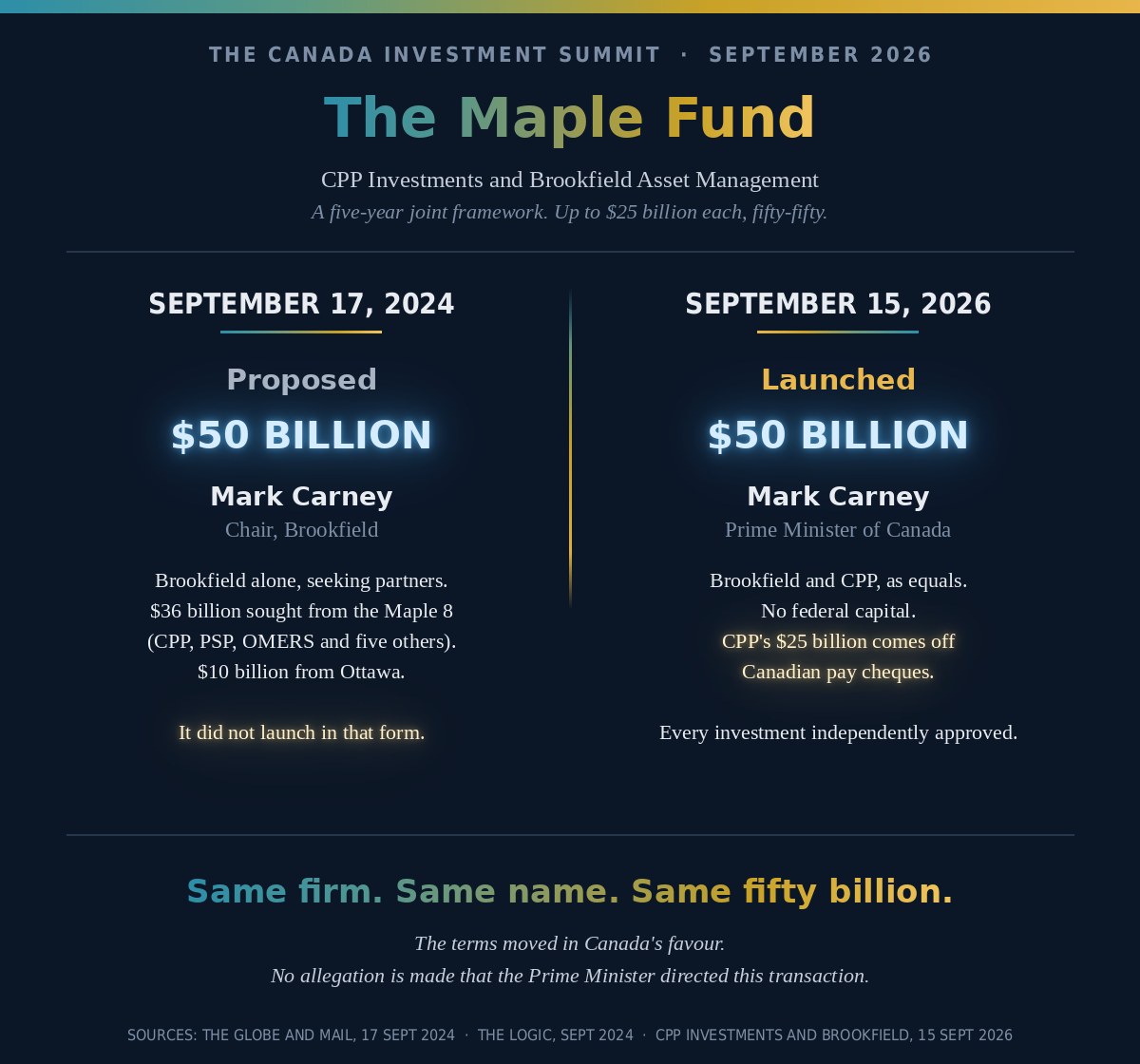
None of that would raise an eyebrow in business. A proposal that stalls, gets restructured, and lands two years later with a better partner on better terms is an ordinary success story. In a boardroom it would be a case study in persistence.
Which is the whole problem, and I will come back to it.
The mechanism exists, which is the point
Canada anticipated this situation. The Prime Minister has a formal Brookfield-related conflict of interest screen, agreed under section 29 of the Conflict of Interest Act and published by the Office of the Conflict of Interest and Ethics Commissioner. It exists precisely so that a person with a long private-sector history can serve without every decision becoming an argument.
A screen only works when people can see it worked.
It is a compliance mechanism,
not a character reference.
That does not mean every step must be narrated in public. A screen can operate perfectly well without disclosure of confidential advice or deliberations. But where the surrounding facts create an obvious public question, a limited confirmation that the mechanism was engaged protects confidence at almost no cost.
I have found no public confirmation that it was engaged in this instance. The silence is doing more damage than the confirmation would.
The rules are different here
In business, relationships are an asset. Knowing the right people, calling someone you have known for twenty years, doing a deal with a counterparty you trust because you have watched them operate. None of that is corruption. It is competence. It is, in large part, what a good dealmaker is for. Nobody in finance apologizes for a rolodex.
In government, the same relationships require a different discipline. Disclosure, separation, and, where necessary, recusal.
Not because the people are worse. Because the power is different.
A private business can decide whom it trusts and whose capital it will accept. Public office carries another obligation. Even where the government neither supplies the money nor directs the investment, the public must be able to distinguish government influence from independent commercial judgment.
Which is why the standard in public life is not only whether a decision was a good one. It is also whether the public can see that it was arrived at cleanly.
People coming from the private sector often hear that as a lesser test. Appearances, optics, theatre. It is not a lesser test. In public life it is part of the test, because the public cannot audit the room. We do not see the meetings, the calls, the judgment calls, or the twenty years of knowing someone. All we can see is the shape of the thing from outside. So the shape has to be clean, or the trust that makes government possible starts to go.
That is the category error. Not an ethical failure. A failure to notice which set of rules applies now.
The part we should be asking about
There is a second thing in this announcement that deserves attention and is not about anyone’s conduct.
CPP Investments will commit up to $25 billion. That capital originates in mandatory contributions made by roughly sixteen million Canadian workers and their employers. It is not government revenue, and governments do not direct how it is invested. But neither is it ordinary private capital supplied by people who freely chose an investment manager. Nobody opted in.
Contributors will benefit if those investments strengthen the fund, and that benefit is real. I am not going to pretend it away.
What they will not receive is a share in anything. The Canada Pension Plan is a defined benefit. Your pension comes from a formula. A record quarter does not raise your cheque, and a poor one does not lower it. Investment performance supports the plan collectively and over time. It does not flow into an individual account, and it does not produce title to a port, a power system or a data centre.
That is the design, and it has served this country well. But it means we should be precise about what is happening. Canadians supply the capital through compulsory contributions and share collectively in the strength of the plan. CPP Investments holds and controls the assets. Contributors acquire no direct ownership or governance rights in the projects their capital finances.
Those are different things, and only one of them
is being celebrated this week.
This is not a complaint about the pension. It is a question about the assets.
What I am actually asking for
Nothing dramatic.
A limited confirmation that the screen was engaged in relation to the Maple Fund.
And, as the fund begins to invest, project-level reporting after definitive agreements are signed. What was acquired, how much CPP Investments committed, and who exercises operational control.
Neither ask slows a single deal, and both would make an initiative that could genuinely serve this country considerably easier to defend. There are eighteen more ideas in the appendix, some better than these.
Accountability is not the opposite of ambition.
It is the thing that lets ambition survive
contact with the public.
Appendix: twenty places to begin
I do not believe contributors should vote on individual investments. A pension fund cannot be run by referendum, and political direction would destroy the independence that made CPP Investments successful in the first place.
But independence and silence are not the same thing. Federal law already requires public meetings. The founding governance principles already recognize accountability to contributors. Nothing below asks anyone to abandon a fiduciary duty.
Every option carries a drawback, and I have stated each one. That is not an argument for doing nothing. It is the beginning of the discussion.
Pick one. Combine five. Reject the rest.
Measures CPP Investments could adopt tomorrow
Publish a Maple Fund deal sheet.
After each transaction closes, disclose the asset, the CPP commitment, the ownership percentage, the partner, the concession term and the governance rights.
Drawback: some commercial terms must stay confidential.
Create a user-pay asset register.
Identify the Canadian investments where contributors also pay tolls, fares, fees or utility charges.
Drawback: critics may misread user charges as proof an investment is improper.
Issue a “where your CPP is working” statement.
A plain-language annual account of the major Canadian holdings and what they produce.
Drawback: simplification can obscure genuine portfolio complexity.
Disclose control, not only ownership.
State who appoints directors, sets fees, runs operations and holds veto rights in every major infrastructure deal.
Drawback: partners may resist revealing governance arrangements.
Publish post-closing public interest assessments.
The return, the public service involved and the principal risks, after definitive agreements are signed.
Drawback: the mandate is financial, not general public policy.
Report Canadian user revenue.
For toll roads, airports and utilities, disclose how much revenue comes from Canadian users.
Drawback: disaggregated figures may be commercially sensitive.
Build an infrastructure transparency portal.
All domestic holdings, ownership structures, partners and concession expiry dates, in one searchable place.
Drawback: ongoing administrative work, and very little else.
Answer public meeting questions in writing.
Publish every substantive question and a written answer after the legally required public meetings.
Drawback: could invite repetitive or politically organized questioning.
Giving contributors an actual voice
Establish a Contributor Advisory Council.
An independent body representing workers, retirees, employers and the self-employed.
Drawback: it must stay advisory, or investment independence goes.
Select a Citizens’ Pension Assembly by lottery.
A representative group of contributors examines one major issue each year and publishes recommendations.
Drawback: deliberative assemblies cost money and cannot master every investment.
Create a CPP Contributor Advocate.
One independent office with authority to ask questions, obtain non-public briefings and report publicly, without directing a single investment.
Drawback: access to confidential information needs strict safeguards.
Reserve contributor perspectives on the board.
Directors with demonstrated experience representing contributors and beneficiaries.
Drawback: directors still owe duties to the organization as a whole, not to a constituency.
Hold transaction-specific hearings.
A public session before CPP enters an unusually large domestic infrastructure vehicle.
Drawback: advance disclosure could weaken negotiations and politicize investment.
Consult without holding a referendum.
Ask contributors about principles. Transparency, affordability, and domestic exposure. Not about deals.
Drawback: consultation creates expectations that cannot govern fiduciary decisions.
Protections for airports and other public infrastructure
These belong in the government’s concession agreements, not in CPP Investments’ mandate.
Cap passenger fee increases.
Tie airport charges to inflation, to service improvements, or to an independent regulator’s approval.
Drawback: less pricing flexibility may lower the price investors offer.
Require open-book concession accounting.
Give the public regulator audit rights over revenues, costs, related-party fees and distributions.
Drawback: investors will seek protection for commercially sensitive information.
Share excess returns with the public.
Above an agreed return threshold, split additional profits with the airport, regional infrastructure or travellers.
Drawback: complex formulas invite accounting disputes.
Build in expiry and reversion.
A finite concession, no automatic renewal, and operations and improvements return to the public at expiry.
Drawback: shorter concessions may attract less investment or higher financing costs.
Retain a public interest golden share.
Government veto over asset sales, major fee changes, service reductions and changes in foreign control.
Drawback: too much veto power blurs operational responsibility and lowers value.
Create a passenger or citizen dividend.
Return part of extraordinary concession profits through fee credits, regional airport support, or a broadly distributed Canadian infrastructure dividend.
Drawback: a CPP-linked rebate would conflict with the defined benefit design and create real equity problems between contributors. A general public mechanism, separate from the plan, is the workable version.
The five that would do the most work
A public Maple Fund deal sheet after every closing.
Disclosure of ownership and actual control rights.
A register of Canadian user-pay infrastructure.
A permanent CPP Contributor Advocate.
Airport concessions with fee protections, open-book audits, excess-return sharing and mandatory reversion.
Those five preserve CPP Investments’ independence completely. They let no politician and no opinion poll choose an investment. They address the actual gap, which is this.
People compelled to supply the capital should be able
to see what it bought, who controls it,
and what they will pay to use it.
If one of these is worth building, someone better placed than me will say so.
Respectfully,Angela Lindow, Toronto.
Sources: James Bradshaw, The Globe and Mail, 17 September 2024. The Logic, September 2024. CPP Investments and Brookfield, 15 September 2026. Prime Minister’s keynote, Canada Investment Summit, 15 September 2026, as reported by The Canadian Press and BNN Bloomberg. John Graham, CPP Investments, May 2026. Office of the Conflict of Interest and Ethics Commissioner. Research assisted by AI.