
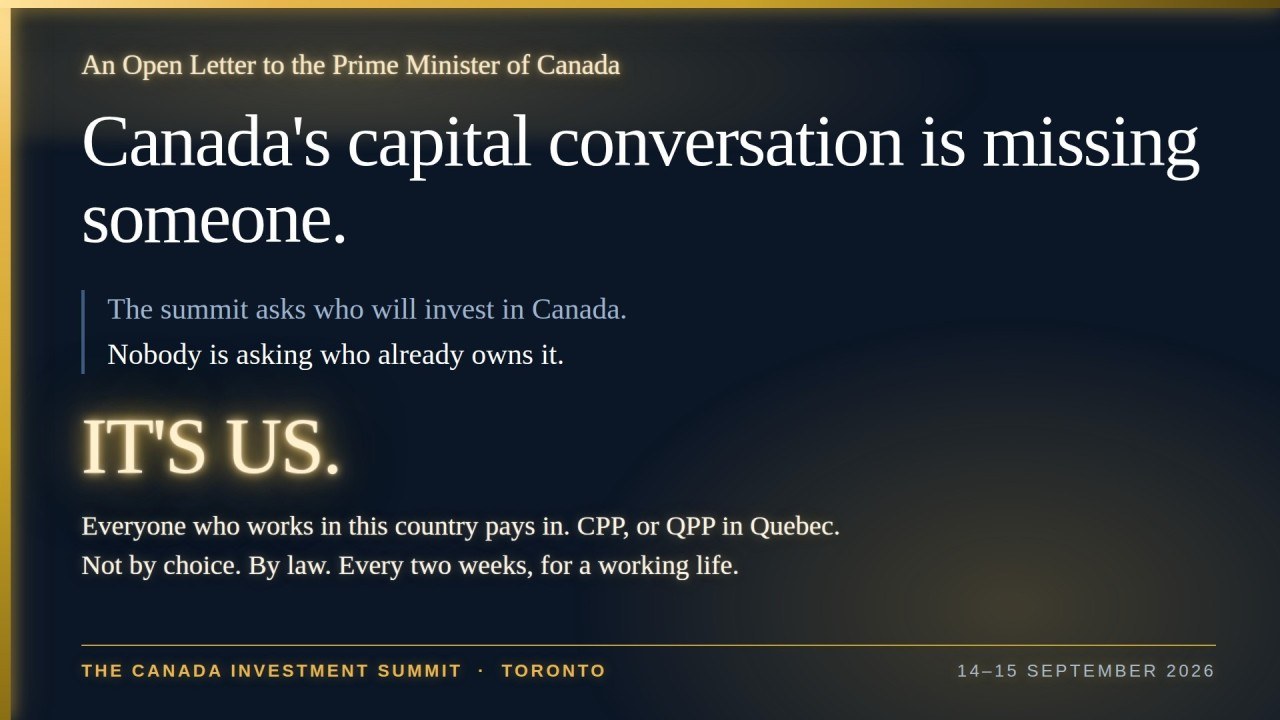
AN OPEN LETTER TO THE PRIME MINISTER OF CANADA
Canada’s capital conversation
is missing someone.
Prime Minister,
Tomorrow you open Canada’s first national investment summit. Hundreds of global and domestic investors with trillions under management, a downtown Toronto hotel, two days, and a target of catalysing one trillion dollars of investment into this country over five years. Premiers arriving with project lists. Alberta with thirty four. Saskatchewan pitching energy, critical minerals, defence and agriculture. New Brunswick bringing a port expansion, a power plant rehabilitation, and a data centre.
Let me begin with something you may not often hear from people outside your party.
You are right about the problem. Canada’s business investment shortfall has dragged on productivity for two decades, and economists have described it as the country’s Achilles heel. You identified it, you built an agenda around it, and eighteen months on, this summit is that agenda made visible. Whatever anyone thinks of the politics, that is a government that found a structural weakness and went at it, rather than announcing a programme and hoping.
And you of all people understand what capital is and what it does. Governor of the Bank of Canada. Governor of the Bank of England. Chair of Brookfield Asset Management. You have sat on every side of this table, which is precisely why I think you will recognize what I am about to say rather than dismiss it.
So bring the trillion dollars. Build the ports. Build the mines. Build the country.
Now let me finish the sentence. The summit asks: who will invest in Canada? There is a second question underneath it, and I have not heard anyone ask it.
Who already owns Canada’s capital?
Because this summit is not being organized by your office alone. It is co-organized with the Canada Pension Plan Investment Board and Public Sector Pension Investments, two of the largest asset managers in the country, sitting at the head of the table.
That money is not sovereign wealth. It is not a fund anyone chose to buy into. Everyone who works in this country pays in. CPP, or QPP in Quebec. Not by choice. By law. Every two weeks, for a working life, with no opt-out and no vote.
The Canadian Press called this your capital agenda. I would put it a different way, and I think it is the more accurate one.
Canadians are not merely contributors to this.
We are the working capital.
So when the room fills tomorrow, Canada arrives as seller and owner at once. Voluntary investors have a market. Compulsory contributors have something else.
Prime Minister, that compulsory quality is the whole of my argument, and I want to be precise about what I am not saying.
I am not asking you to direct pension managers where to invest. That is a bad idea, it would damage the institutions, and you would be right to refuse it. Their independence exists for sound reasons and I would defend it in the same breath.
I am asking something prior to that. If mobilizing long-term capital has become a central pillar of Canada’s economic strategy, what mechanism exists for the people compulsorily supplying that capital to understand, scrutinize and participate in how it is deployed?
Not a rhetorical question. An institutional one. Where is that mechanism? What is it called? Who convenes it? When does it meet?
The answer we are always given
Don’t worry. You’ll get your pension. Getting the pension was never the thing in doubt. Nobody was asking whether the cheque arrives. The cheque is the floor, and the floor was never in dispute.
The conversation is about the forty years in between. What gets built with the money while we wait. Which sectors it backs. What risks were weighed, and by whom. And whether the people supplying it ever learn what was decided before they read about it in a press release.
One live example, on your own agenda
New Brunswick is bringing a data centre to the table. Data centres are the physical form of artificial intelligence, and AI infrastructure is where an enormous share of institutional capital is now going. It is also, this month, the subject of an extraordinary public argument.
Last week a researcher who had worked at two frontier AI companies resigned and wrote that the people building these systems earnestly believe they could kill us all within the decade. The alignment science lead at one of those companies replied publicly that he agreed, and put his own estimate above ten per cent. Bloomberg, CNN, CNBC, CBC and Axios all carried it. The same news page that announced your summit is also carrying a story about an AI chief executive calling for the industry to slow down.
Reasonable people disagree about whether they are right. I am not asking you to adjudicate that, and I do not know the answer myself.
But if everyone who works in this country is a compulsory contributor to one of the world’s largest pools of institutional investment capital, and Canada intends to mobilize that capital toward the technologies shaping the next economy, then we deserve transparency about how that risk is being assessed when our money is deployed.
That is not an anti-investment position. It is the opposite. It is what a mature capital nation does, and it is the sort of question a central banker asks before writing a cheque rather than after.
What I would leave with you
You have spent a career explaining capital to people who already understood it. The more interesting project, and I suspect the more durable one, is explaining it to the people who have been supplying it all along without ever being asked into the room.
What would it look like if Canadians understood themselves not simply as taxpayers, workers and future retirees, but as participants in the ownership of this country’s long-term capital?
Not inputs. Participants.
The distinction is the entire argument.
Bring the trillion dollars, Prime Minister. Build the ports and the mines and the power. Fix the Achilles heel. I want all of it, and I want it built here.
And while you are doing it, tell us what we own. Then tell us who speaks for us.
Because there is a board, and there is management, and there are ministers of finance who meet periodically to review the plan. There is no one in that structure whose job is to represent the people the money came from.
We are the only party to this arrangement
with no seat and no voice,
and we are the party who cannot leave.
That is the thing I would most like you to think about between now and Tuesday evening.
Respectfully,Angela Lindow, Toronto, 13 September 2026.